Antimicrobial resistance, AMR, is outpacing the clinical pipeline of new drugs, and peptide-based therapeutics face an additional hurdle: proteolytic degradation limits their utility in biological environments. One strategy to sidestep both problems is to fuse nucleobases with amino acids into a single amphiphilic scaffold. The resulting nucleopeptides gain biostability through modified termini and acquire supramolecular self-assembly properties that can enhance membrane-targeting potency. Invasive fungal infections caused by drug-resistant Candida species add urgency to the search, as existing antifungal options are few and often toxic. A molecular platform that addresses bacteria and fungi simultaneously, at low doses, and with selectivity for microbial over mammalian membranes would represent a meaningful step toward next-generation antimicrobial therapeutics.
Researchers in the Banerjee Group at the Indian Association for the Cultivation of Science, an autonomous body under the Department of Science and Technology, Govt. of India, published in Organic & Biomolecular Chemistry, designed and synthesized three amphiphilic cationic nucleopeptides bearing a thymine nucleobase at the N-terminus, L-lysine and L-phenylalanine residues in the backbone, and fatty acyl chains of C8, C12, or C14 length at the C-terminus, yielding TNP8, TNP12, and TNP14, respectively. Solution-phase DCC/HOBt coupling produced each compound, and HPLC-purified samples were self-assembled in Milli-Q water at pH 6.9 by heating to approximately 100 °C followed by slow cooling. Protease stability was confirmed by incubating the nucleopeptides with chymotrypsin, proteinase-K, and pepsin for 72 hours, with no detectable degradation by high-resolution mass spectrometry. Antimicrobial activity was assessed against clinically isolated multidrug-resistant Gram-positive and Gram-negative bacteria and fluconazole-resistant Candida strains, using disc-diffusion and broth microdilution methods following CLSI 2021 guidelines.
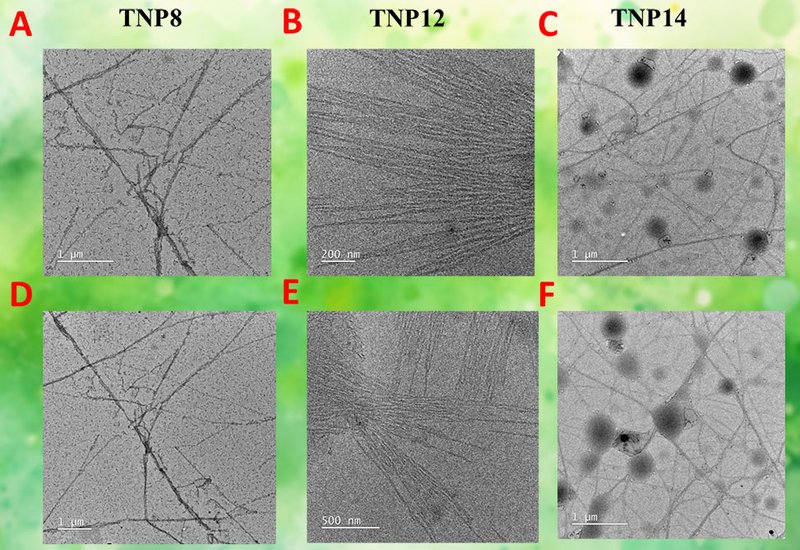
FEG-TEM imaging confirmed that all three nucleopeptides form nanofibers in aqueous solution, with average widths of 45.6 nm for TNP8, 17.4 nm for TNP12, and 51.9 nm for TNP14. Against six multidrug-resistant bacterial strains, including methicillin-resistant Staphylococcus aureus, MRSA, and streptomycin-resistant Escherichia coli, TNP12 achieved minimum inhibitory concentrations, MICs, of 7–15 μM, outperforming both TNP8 and TNP14; TNP14 was inactive across all bacterial strains tested. Mechanistic studies with the ANS fluorescence probe confirmed dose-dependent outer membrane permeabilization by TNP12 in E. coli, while propidium iodide uptake assays showed equivalent inner membrane disruption in both MRSA and E. coli. FE-SEM micrographs of TNP12-treated cells showed complete membrane rupture and leakage of cytoplasmic contents. Live/dead BacLight confocal imaging corroborated these findings: treated cells displayed strong red propidium iodide fluorescence and deformed morphologies, whereas untreated controls showed intact green SYTO-9 staining. DCFDA fluorescence assays demonstrated that TNP12 also induced dose-dependent intracellular reactive oxygen species, ROS, generation in bacterial cells, adding oxidative stress as a second mechanism of cell killing beyond membrane disruption.
Antifungal activity followed a parallel pattern. Against fluconazole-resistant Candida albicans, Candida glabrata, and Candida tropicalis, TNP12 achieved MICs of 7.9–15.9 μM, whereas TNP14 was inactive against all three strains and TNP8 showed partial activity. ROS generation assays with DCFDA against C. tropicalis placed TNP12 above TNP8 and TNP14 in intracellular oxidative output, and FE-SEM confirmed membrane disintegration in treated fungal cells. Cytotoxicity profiling in HEK-293 cells by MTT assay gave IC50 values exceeding 100 μM for all three nucleopeptides, well above their antimicrobial MIC range. Hemolysis assays at doses of 10, 50, 100, and 500 μM showed less than 10% hemolysis for each compound, consistent with a selective action on microbial rather than mammalian membranes.
The structure-activity relationship that emerges from this series points to C12 chain length as an optimal balance between hydrophobicity and hydrophilicity for interacting with negatively charged microbial membranes. The C14 compound exceeds a hydrophobicity threshold that appears to compromise both self-assembly geometry and membrane selectivity, while C8 is too short to drive effective membrane integration. The dual bactericidal and antifungal efficacy of TNP12 at low micromolar doses, combined with protease resistance and a wide therapeutic window relative to human cells, positions this nucleopeptide scaffold as a rational design lead for combating AMR. The authors suggest that the thymine nucleobase contributes both to biostability and to the supramolecular nanofiber architecture that concentrates antimicrobial activity at membrane surfaces, providing a framework for further optimization of nucleopeptide-based therapeutics.